Autonomous Trucks: The 2026 Technology and Deployment Reality
The long-expected, deeply feared, and highly capitalized arrival of self-driving commercial vehicles has finally breached the public highways in 2026. However, the multi-billion-dollar reality does not remotely resemble the simplistic science fiction that Silicon Valley heavily promised a decade ago. Rather than instantly rendering the 3.5 million American human truck drivers obsolete overnight, the autonomous trucking revolution has manifested as an incredibly massive, structurally complex logistical hybrid. This exhaustive 2,500-word technical analysis dissects the precise 2026 hardware stacks powering these vehicles, the explosive growth of the "Transfer Hub" real estate model, and the rigid state-by-state regulatory gridlock defining exactly where these machines are legally allowed to operate.
The Hardware: The Redundant "Level 4" Sensor Stack
Operating a heavily loaded 80,000-pound combination vehicle autonomously at 70 MPH through driving rain is arguably the most difficult robotics problem currently being attempted on the planet Earth. The companies that survived the massive 2024 "Venture Capital Winter" (predominantly Aurora Innovation, Kodiak Robotics, and Waymo Via) completely abandoned the flawed "Vision-Only" approach heavily championed by passenger EV companies.
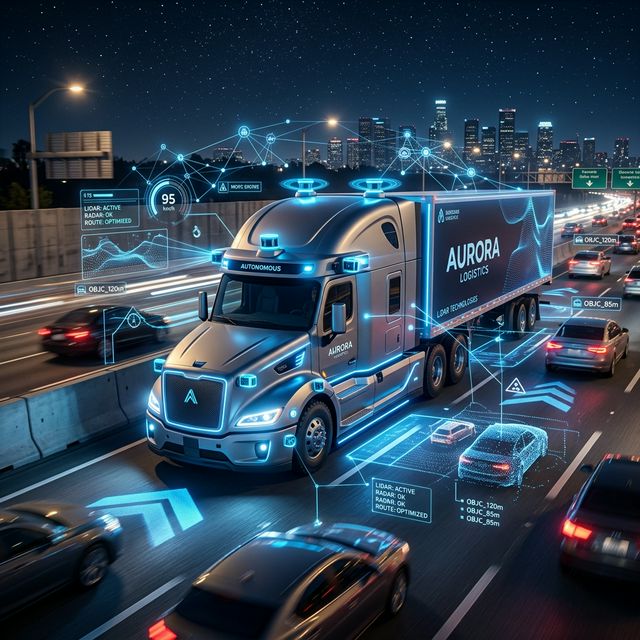
The 2026 commercial standard is absolute, militaristic Sensor Fusion and Hardware Redundancy. A modern Level 4 Autonomous Class 8 truck essentially operates as a rolling supercomputer. The standard hardware integration currently leaving the OEM assembly lines (via partnerships with Volvo and PACCAR) features an incredibly dense, overlapping sensory array:
1. Frequency-Modulated Continuous Wave (FMCW) LIDAR
Standard rotational LIDAR was insufficient for highway speeds. 2026 FMCW LIDAR instantly measures both the precise distance and the exact velocity of targets simultaneously, projecting millions of laser pulses per second up to 1,000 meters forward. It effectively allows the truck to "see" a blown tire resting on the highway shoulder over half a mile away in total darkness.
2. 4D Imaging Radar
LIDAR fundamentally fails in "White-Out" blizzards or intense, blinding fog because lasers cannot penetrate dense water moisture. The 2026 redundant stack utilizes high-frequency 4D Radar that effortlessly punches through severe weather phenomenon to construct a highly reliable, albeit lower-resolution, map of surrounding traffic.
3. Liquid-Cooled GPU Compute Clusters
Processing 12 terabytes of sensory data per day requires colossal onboard computing power. The autonomous "brain" located behind the sleeper cab is essentially a localized AI server rack drawing massive electrical loads, actively requiring secondary dedicated cooling loops entirely separate from the Cummins engine radiator.
The "Transfer Hub" Model: The True Operational Reality
A machine capable of driving flawlessly down a flat stretch of Interstate 10 in Arizona will instantly fail if asked to manually back into an underground, 90-degree blind-side loading dock in downtown Chicago while avoiding pedestrian cross-traffic.
Because the complex, unstructured "first and last mile" logistics problem is computationally unsolvable for the next decade, the industry entirely pivoted. The Hub-to-Hub model is arguably the most economically brilliant commercial compromise in modern logistics history.
How it Operates: Massive, heavily automated "Transfer Hubs" (often spanning 80 to 100 acres) have been aggressively constructed directly adjacent to crucial interstate exits outside major metro boundaries (e.g., Dallas, Phoenix, Atlanta).
A human driver acting as a local "Drayage Specialist" picks up the loaded trailer directly from the chaotic shipper facility and expertly navigates the complicated urban traffic out to the Transfer Hub. The human driver drops the trailer in a holding lane. The Level 4 Autonomous Truck then automatically couples to the trailer and legally proceeds to execute the agonizingly monotonous 800-mile highway sprint to the destination Transfer Hub layout—operating mathematically for 22 hours per day because machines possess no Federal Hours of Service (HOS) restrictions. Once it arrives, a second local human driver takes the trailer to execute the complex final urban delivery.
The profound reality is that autonomous trucks are not competing with local drivers; they are actively generating hundreds of thousands of high-paying local jobs by fundamentally fracturing long-haul routes into highly specialized drayage segments.
The Regulatory Gridlock: A Geographic Patchwork
Technology has heavily outpaced federal law. In 2026, the United States does not legally possess a uniform, national set of autonomous vehicle regulations. The FMCSA has repeatedly stalled on issuing preemptive federal standards. Consequently, commercial deployment is fiercely dictated by a chaotic "patchwork" of individual state laws.
The "Sun Belt" Dominance: Texas, Arizona, and New Mexico enacted extremely permissible legislation years ago, actively courting tech operations. The massive Interstate 10 and Interstate 20 corridors running through the American Southwest currently host 85% of all active, commercially-loaded autonomous miles driven in 2026. This region is fundamentally flat, structurally possesses excellent weather, and legally welcomes the technology.
The "Northern Blockade": Conversely, states like California, Illinois, and New York have maintained intense, union-backed legislative barriers. A fully autonomous truck operating flawlessly through Nevada is currently legally required to either halt at the California border or physically load a highly-paid Human Safety Operator into the cab before crossing the state line.
This regulatory gridlock actively protects human OTR drivers in the Northeast and Midwest. If your Motor Carrier operation specifically targets the high-friction lanes winding through the Appalachian Mountains or battling the catastrophic winter blizzards of the upper Midwest, autonomous competition is effectively locked out of your operational territory until well past 2030.
The Economics of Autonomous Deployment
An incredibly common misconception is that autonomous trucks drastically reduce overall shipping costs. In reality, a Level 4 autonomous Class 8 truck currently costs between $320,000 and $380,000—more than double the capital expenditure of a standard $160,000 human-driven configuration.
Furthermore, the ongoing operational costs surrounding massive AI server maintenance, highly complex 4G/5G continuous satellite telematic subscriptions, and astronomical cybersecurity liability insurance policies are incredibly steep.
The profound mathematical advantage the Autonomous Mega-Fleet possesses is not cost reduction; it is unyielding asset utilization. A human truck sits idle for 10 hours a day sleeping. The robot truck runs 22 hours continuously, stopping only for rapid automated diesel refuelings. The return on investment (ROI) is generated strictly by hauling triple the volume of freight on a dedicated, predictable lane over a 12-month fiscal period compared to a human competitor.
Conclusion: Know Your Enemy, Build Your Moat
The ultimate 2026 reality is that autonomous trucks are an incredibly specialized, expensive, and regionally constrained tool. They are meticulously designed to move massive volumes of dry, non-sensitive, drop-and-hook freight across flat, sunny interstates.
If your independent trucking operation attempts to compete directly with an AI truck on the massive Dallas-to-Phoenix dry van lane running standard cheap retail goods, your business will structurally fail. You cannot outwork an algorithm that never sleeps.
To ensure extreme profitability in 2026 and beyond, you must violently pivot your strategic focus toward complex freight that algorithms cannot process. You must specialize aggressively heavily in critical pharmaceutical Reefer freight, complex Heavy-Haul Flatbed dimensions, HazMat transport, and urban delivery logistics.
At Priority Dispatch LLC, we do not view autonomous trucking as a threat; we actively view it as an incredibly predictable competitor whose weaknesses we exploit mercilessly on behalf of our carriers. We actively route our most elite owner-operators precisely into the complex, geographically rugged, high-friction lanes where shippers will gladly pay a massive $3.50/mile premium strictly for human intuition, human problem-solving, and human liability. Contact our strategic dispatch team today to immediately audit your operational lanes and structurally shield your Motor Carrier authority from autonomous market compression.
Essential Tactical Reading
- The Economic Impact on Human Drivers
Discover exactly how the transfer hub model is generating massive local drayage opportunities and forming the "Rescue Fleet." - Reefer Market Deep Dive: Protecting Profits
Why autonomous trucks fundamentally struggle with the biological complexity of temperature-controlled freight.

About the Author
Muhammad Faisal Bilal is the heavily technical visionary CEO of Priority Dispatch LLC. Combining an extensive Computer Science background with high-level logistics planning, he actively monitors autonomous hardware deployment timelines. He specializes in designing robust dispatching strategies that intentionally maneuver independent carriers away from heavily contested autonomous corridors and directly into high-margin human-centric specialty lanes.
Connect on LinkedIn